



Why AI Feels Relevant to Livestreamers
Artificial intelligence is everywhere right now, but for livestreamers, content creators and businesses using live video, the real question is not whether AI exists. It is where AI can genuinely help without making your content feel generic, over-produced or disconnected from the human presence that makes live content work in the first place.
That matters because livestreaming is not just another content format. It is built on presence, personality, timing, trust and interaction. People do not show up to a live show simply because words appear on a screen. They show up because there is a real person there, a real point of view and a real sense of connection. In a digital world becoming more automated by the week, that human edge is not less valuable, it is more valuable.
That is also why the AI conversation can feel confusing for creators. On one side, you are told AI will save time, speed everything up and transform your workflow. On the other, you see bland content, over-confident nonsense and far too many people acting as if the tool itself matters more than the quality of what they are saying. Both things can be true. AI can absolutely support better livestream workflows, but it should support the work, not replace the thinking behind it. Microsoft and LinkedIn found that 75% of knowledge workers were already using AI at work in 2024, while Stanford reported that 78% of organisations used AI in 2024, up sharply from the year before. The pace IS real. The hype is real too.
Where AI Can Help Before You Go Live
For livestreamers, the most useful place to start is with planning. AI can be excellent for helping shape an episode outline, generating possible titles, drafting initial talking points, suggesting topic angles and even helping organise a series structure. It is especially useful when you already know what you want to say but need help shaping it faster and more clearly. That is very different from letting AI invent your whole show for you. A good livestream still needs your judgement, your voice and your understanding of your audience. Whilst AI can help organise the thinking, it should not replace the thinking.
It can also be genuinely useful in pre-production. If you are preparing a guest interview, AI can help summarise background research, pull together likely themes, suggest audience questions and help you identify useful hooks or talking points. If you are running a branded show for a business or organisation, it can help you structure a cleaner running order, prepare draft descriptions and shape promotional material that can then be refined into your own tone. Used properly, that can reduce friction and save a meaningful amount of time. Many workers already say AI helps them save time, boosts creativity and allows them to focus on higher-value work, which helps explain why practical adoption has moved so quickly.
How AI Helps After the Broadcast
Now, where AI becomes especially powerful for livestreamers is after the live broadcast. Repurposing is one of the biggest opportunities in live video and it is also one of the biggest reasons many creators and businesses fail to extract enough value from the content they produce. A one-hour livestream should not be treated as a one-off event. It can become a full digital engagement package, including short video clips, a Knowledge Hub blog article, a podcast version and scheduled social media content that keeps your message visible and working for you afterwards. AI can help speed up each of those stages. It can support transcript clean-up, identify key moments, suggest highlight themes, draft article outlines from the show and help create a first pass at social captions. That does not mean the output should go out untouched. It means the heavy lifting becomes lighter.
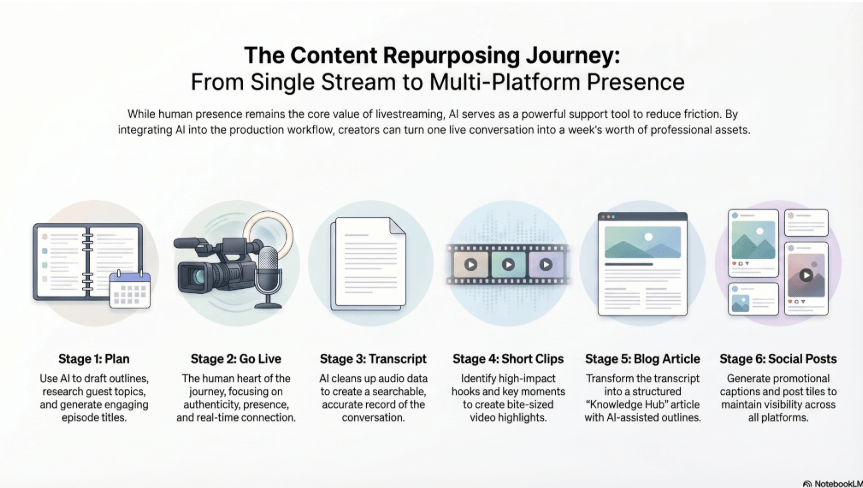
This is particularly relevant for solo operators, lean teams and businesses trying to stay visible without burning out. McKinsey’s 2025 survey found that organisations most often report using generative AI in areas such as marketing and sales, product and service development and service operations. In other words, the strongest use cases are often not abstract. They sit inside real workflows where speed, structure and consistency matter. Livestreaming sits right in that space because it naturally connects planning, communication, production, repurposing and distribution.
In simple terms, livestreaming should sit at the centre of a wider content and digital engagement system.
Where Human Judgement Still Matters Most
That said, there are clear limits and they matter.
AI can draft, but it cannot replace lived experience.
AI can summarise, but it cannot replace timing.
AI can suggest, but it cannot replace instinct.
AI can accelerate output, but it cannot replace presence.
This is crucial for livestreamers because the thing that makes live content work is not simply efficiency. It is authenticity. It is the sense that a real person is there, thinking, responding, leading, reacting and connecting in real time. If AI strips too much of that away, the content may become faster to produce but weaker to experience.
This is where many creators go wrong. They use AI to speed up the wrong things. They use it to produce bland scripts, generic promo copy or lifeless content that sounds technically fine but emotionally empty. They end up with something polished on the surface and forgettable underneath. That is not a tool problem. That is a judgement problem.
A better approach is to use AI where it reduces friction and saves time, while keeping the core human parts firmly in human hands. For most livestreamers and live-video-led businesses, that means AI can support:
Show planning and topic development
Guest research and episode prep
Draft descriptions and promo copy
Transcript summaries and article outlines
Clip selection support and caption drafting
Content repurposing and scheduling workflows
Basic admin and post-show organisation
What it should not replace is your final point of view, your live presence, your ability to read an audience, your standards around quality and your sense of what is worth saying in the first place.
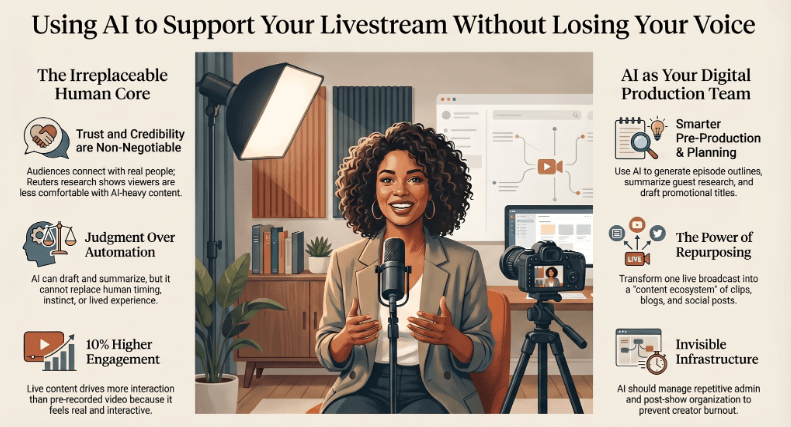
That distinction matters even more now because trust is becoming a bigger issue as AI-generated content spreads. If your name, brand or business reputation sits behind the content, then oversight matters, tone matters, accuracy matters and originality matters. It really is that simple.
Reuters Institute research has shown people are notably less comfortable with content produced mostly by AI, especially in trust-sensitive areas such as news or education/learning. The same wider principle applies to creators and businesses. People still respond to what feels credible, human and earned.
The Smarter Way to Use AI in Livestreaming
So the real opportunity for livestreamers is NOT to become AI-first. It is to become smarter and more selective. Use AI to reduce repetitive effort. Use it to organise, accelerate and repurpose. Use it to help turn one live conversation into a wider content ecosystem, however do not confuse speed with substance or automation with connection.
In the end, that is what great livestreaming still comes down to. A clear voice, a real presence, a useful message and an audience that feels there is an actual person behind the content.
AI can help you do more with your livestreams. It can help you plan better, repurpose faster and stay more consistent. It can help reduce the friction that often stops good creators and good businesses from getting the full value out of live video, but it cannot replace the thing that makes the work worth watching.
That part is still yours.
That distinction matters even more now because trust is becoming a bigger issue as AI-generated content spreads. If your name, brand or business reputation sits behind the content, then oversight matters, tone matters, accuracy matters and originality matters. It really is that simple.
Reuters Institute research has shown people are notably less comfortable with content produced mostly by AI, especially in trust-sensitive areas such as news or education/learning. The same wider principle applies to creators and businesses. People still respond to what feels credible, human and earned.
About the Authors

JOE SHEPPARD
Joe Sheppard is a Digital Engagement Architect and the founder of Livestream Solutions and Livestream Academy. He specialises in livestreaming, digital storytelling and community-led engagement, helping businesses, organisations and creators transform conversations into lasting digital presence. As co-creator of The Insight Exchange, Joe is focused on building smarter, more meaningful media experiences for audiences seeking depth over noise.

SUZI MANLEY
Suzi Manley is the founder of Five Foot Rope Group and a trusted voice in reinvention, visibility and purposeful midlife growth. Her work supports people and organisations ready to move forward with greater clarity, confidence and authenticity. As co-creator of The Insight Exchange, Suzi brings a grounded, human perspective to conversations about business, culture, change and what comes next.
Get in touch with The Insight Exchange :
Name
Message
Type your message here


THE INSIGHT EXCHANGE
Legal & Trust Links
Privacy Policy
Terms & Condition
Cookie Policy
Disclaimer
Newsletter
Subscribe to Get Smart Updates

